
Search the question and every answer agrees. Take a salary of £12,570, the personal allowance, and draw the rest as dividends. It is the most repeated piece of advice in UK contracting, and for a great many companies it is exactly right.
For others it quietly costs over £3,000 a year. The difference comes down to one question most articles never ask.
Why £12,570 became the default
The logic is sound as far as it goes. At £12,570 you pay no income tax and no employee National Insurance, because that is where both begin. Salary is deductible against corporation tax, so it is cheaper to the company than a dividend paid out of taxed profit.
Go higher and employer National Insurance appears. It is charged at 15% on everything above the secondary threshold of £5,000, and for most one-person companies that cost outweighs the corporation tax saved. So you stop at the allowance and take dividends instead.
The question nobody asks
All of that assumes your company pays employer National Insurance. Many do not, because the Employment Allowance covers up to £10,500 of it.
Remove employer National Insurance from the equation and the arithmetic inverts. Salary stops being the expensive route and becomes the cheap one.
The reason is corporation tax. Between £50,000 and £250,000 of profit, marginal relief means each extra pound is effectively taxed at about 26.5%. Salary is deductible at that rate. Dividends are not: they come out of profit that has already been taxed, and are then taxed again in your hands.
Run the comparison on a single extra pound extracted, with the allowance covering employer National Insurance. As salary within the basic rate band you keep 72p. As a dividend you keep about 66p. In the higher rate band the gap widens: 58p as salary against roughly 47p as a dividend.
What that means in practice
| Company profit | Sole director | With the allowance | Cost of the rule of thumb |
|---|---|---|---|
| £60,000 | £12,570 | £12,570 | nothing |
| £100,000 | £12,570 | £75,000 | £1,501 |
| £150,000 | £12,570 | £96,739 | £3,073 |
| £250,000 | £12,570 | £100,001 | £2,894 |
Optimal salary, and what taking £12,570 instead would cost a company that can claim the Employment Allowance.
Free to reproduce with credit: download the animation or the still.
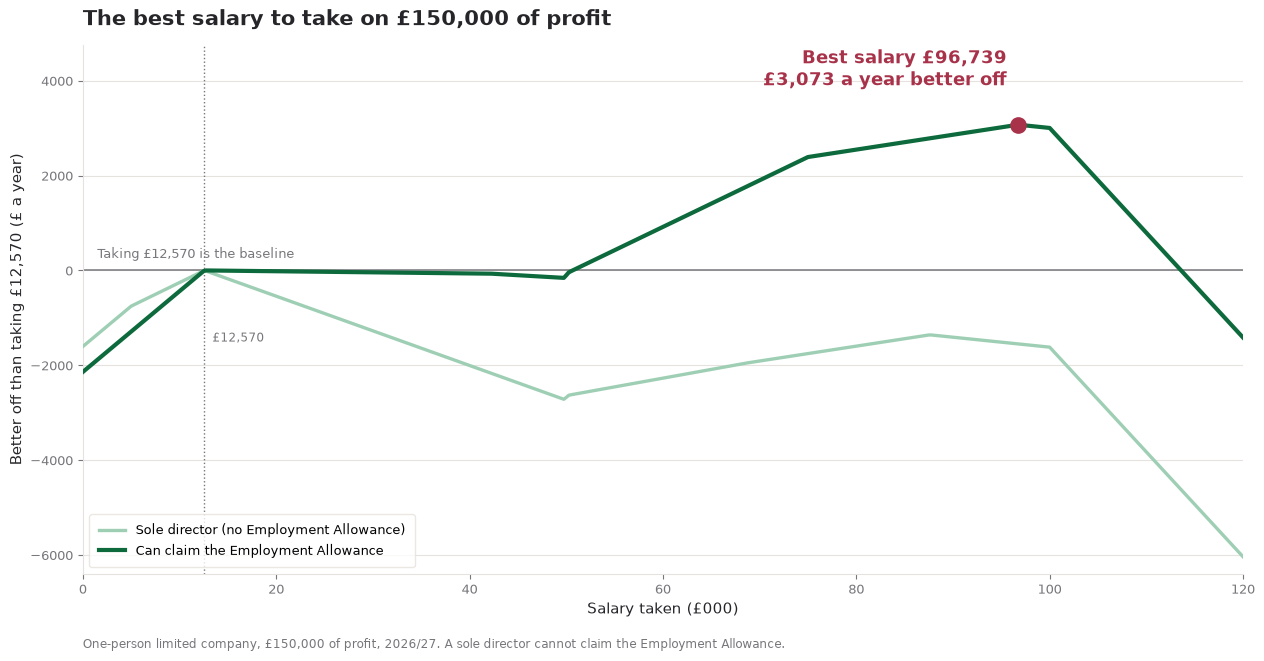
On £100,000 of profit the optimum jumps from £12,570 to £75,000, worth £1,501 a year. At £150,000 it is £96,739. And notice where it stops climbing: around £100,000 of salary, because that is where your personal allowance starts being withdrawn and the 60% trap makes further salary expensive again.
Notice too that at £60,000 of profit the rule of thumb is right even with the allowance. This is not a case of the conventional advice being wrong. It is a case of it being right for one situation and repeated as though it were universal.
The catch that decides it
A company cannot claim the Employment Allowance if its only employee earning above the secondary threshold is also a director. That single sentence settles the question for most one-person contractor companies, and it is why £12,570 genuinely is the answer for them.
Take on one employee paid above the threshold and eligibility changes, and so does the optimal salary, by tens of thousands. It is worth knowing which side of that line your company sits on before copying a number off a forum.
Two things worth doing anyway
Whatever the optimum says, a salary of at least £6,708, the lower earnings limit, earns you a qualifying year towards the state pension even though no National Insurance is payable on it. Setting salary below that to save a few pounds can cost a year of state pension entitlement, which is a poor trade.
And an employer pension contribution is worth considering before either route. It is deductible against corporation tax, attracts no National Insurance at all, and does not touch your personal tax at the point it is paid.
Work out your own figure with the optimal salary and dividend split calculator, which asks the Employment Allowance question and sweeps every salary level rather than assuming. To compare a single extraction both ways, use the dividend versus salary calculator.
Method
Figures are for 2026/27: corporation tax at 19% up to £50,000 and 25% above £250,000 with marginal relief in between, employer National Insurance at 15% above the £5,000 secondary threshold, Employment Allowance of £10,500, dividend allowance of £500 and dividend rates of 10.75%, 35.75% and 39.35%, the first two of which rose by two percentage points on 6 April 2026. Every number here is produced by the same engine as the calculator, so the article and the tool cannot disagree.
General information, not tax advice. Employment Allowance eligibility in particular has conditions this article does not cover, and getting it wrong is expensive. Check with your accountant.