Somewhere just past a £100,000 salary, the tax system stops behaving the way you'd expect. Most people assume that once you're a higher-rate taxpayer, every extra pound is taxed at 40%. But for income between £100,000 and £125,140, the real rate leaps to an effective 60%, and it is one of the least understood corners of UK personal finance.
Free to reproduce with credit: download the animation or the still.
Why the rate jumps to 60%
The culprit is the tapering of the personal allowance. Everyone gets a tax-free personal allowance, £12,570 in 2026/27, but once your income passes £100,000, you lose £1 of that allowance for every £2 you earn above the line. By £125,140, it's gone entirely.
Losing allowance means more of your income becomes taxable at 40%. Stack the tax on the extra pound (40%) on top of the tax you now owe on the allowance you just lost, and the effective rate on that band works out at 60%. Add employee National Insurance and you're paying roughly 62% on income in this zone. You keep less than 40p of every extra pound.
Free Guide
Get the Compound Playbook
Every core move for building wealth in the UK, in one free PDF. Charts, worked examples and a cheat sheet.
Free PDF plus occasional tips and offers. Unsubscribe anytime. Privacy."Between £100,000 and £125,140, you keep less than 40p of every extra pound you earn. A pay rise into this band can feel like almost nothing."
The legal way out: pension contributions
Here's the elegant part. The taper is based on your adjusted net income, and pension contributions reduce it. Put money into a pension (via salary sacrifice or a personal contribution that claims relief) and, as far as the allowance taper is concerned, you never earned it.
So someone earning £115,000 who contributes £15,000 to their pension is treated as if they earned £100,000. They reclaim their full personal allowance, escape the 60% band entirely, and get tax relief on the contribution on top. The effective "cost" of putting that £15,000 into your own pension can be startlingly low, because the taxman was taking most of it anyway.
Free Tool
See your own numbers
Our 60% tax trap calculator shows your effective marginal rate and the exact pension contribution that gets you back to 40%.
Open the calculators →Who this matters to most
If your income sits anywhere near this band, a base salary in the high £90s that a bonus pushes over £100k, for example, this is the single highest-value piece of tax planning available to you. The same move also rescues your Tax-Free Childcare and 30-hours funded childcare, both of which disappear the moment your adjusted income tops £100,000. If you also claim Child Benefit, our High-Earner Tax Optimiser models every trap together and finds the single pension contribution that clears them.
It gets worse than 60%
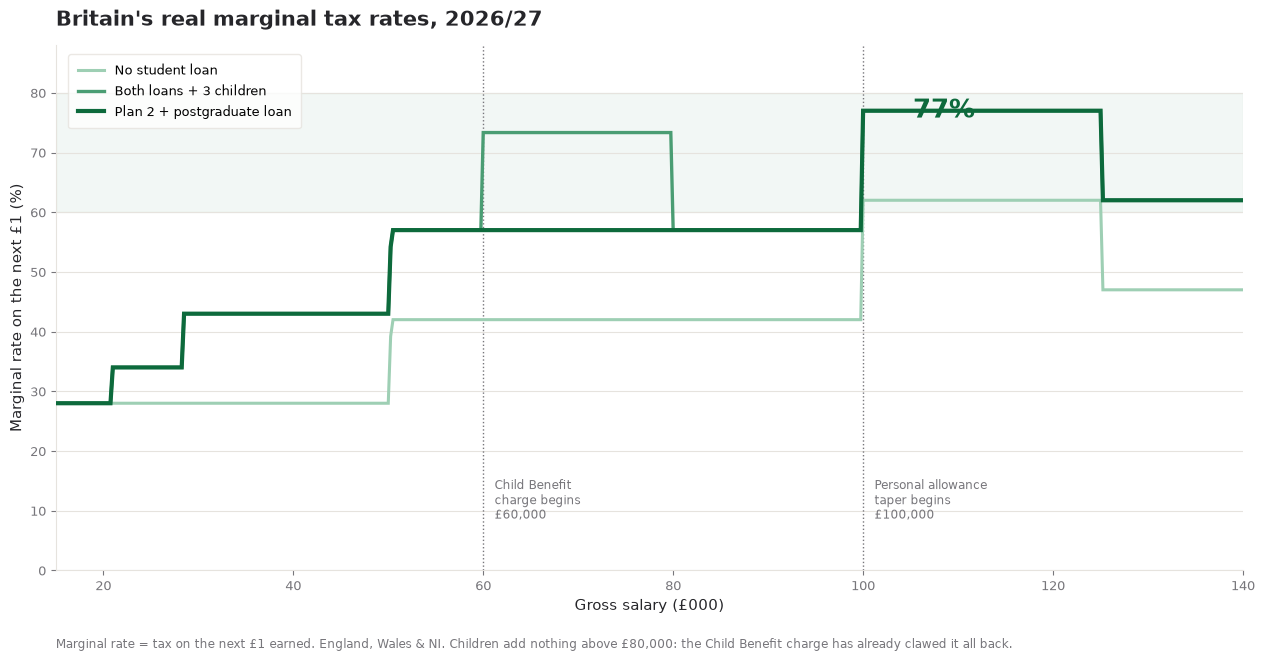
Once the Child Benefit charge and student loans stack on top of the taper, the true peak marginal rate in Britain is 77%, and a second trap starts as low as £60,000. See the full map of 2026/27 rates: when the 60% trap becomes 77%.
The takeaway
The 60% trap isn't a loophole or an error, it's how the rules are written, and it's been made worse by years of frozen thresholds. But it is entirely legal to plan around, and pension contributions are the cleanest tool for the job: you turn money the taxman would have taken into money invested for your own future.