Compound Research
When the 60% tax trap becomes 77%: UK marginal rates mapped for 2026/27
The 60% tax trap between £100,000 and £125,140 is well known. Less understood is how it compounds with the Child Benefit charge and student loan repayments to produce marginal rates as high as 77%. This page maps every combination for the 2026/27 tax year, so you can find your own rate.

Published 25 July 2026 · Modelled by Compound Money for the 2026/27 tax year · Free to reproduce with attribution
What the numbers show
- Anyone repaying both a Plan 2 and a postgraduate loan faces a 77% effective marginal rate between £100,000 and £125,140, and keeps 23p of every extra £1. That is the 60% trap, plus 2% National Insurance, plus 9% and 6% of student loan. Children make no difference at this income: the Child Benefit charge has already clawed everything back by £80,000.
- A second trap runs from £60,000 to £80,000, where the High Income Child Benefit Charge claws back Child Benefit. With three children this reaches 67.3% on a Plan 2 loan alone, or 73.3% with a postgraduate loan on top.
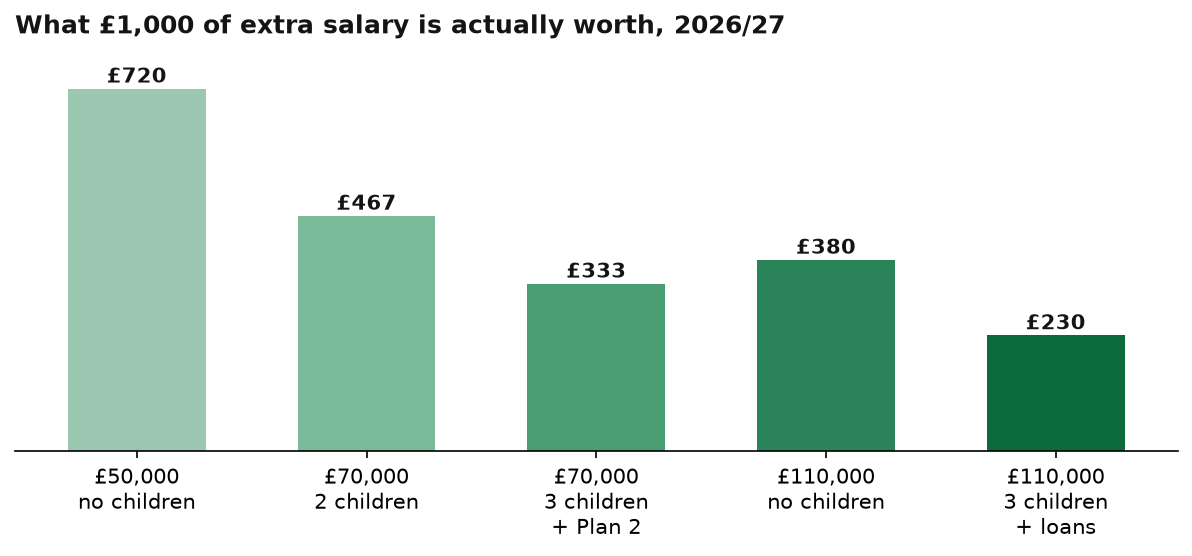
- That means a worker on £79,900 in this position keeps just £273 of a £1,000 pay rise.
- These bands are not aligned with the headline rates. The tax system's official top rate is 45%, yet tens of thousands of middle and upper-middle earners face marginal rates above 70%.
- Because frozen thresholds pull more people into these bands each year, the number affected rises without any rate being changed.
Britain's real marginal rates, mapped
Free to reproduce with credit: download the animation or the still.
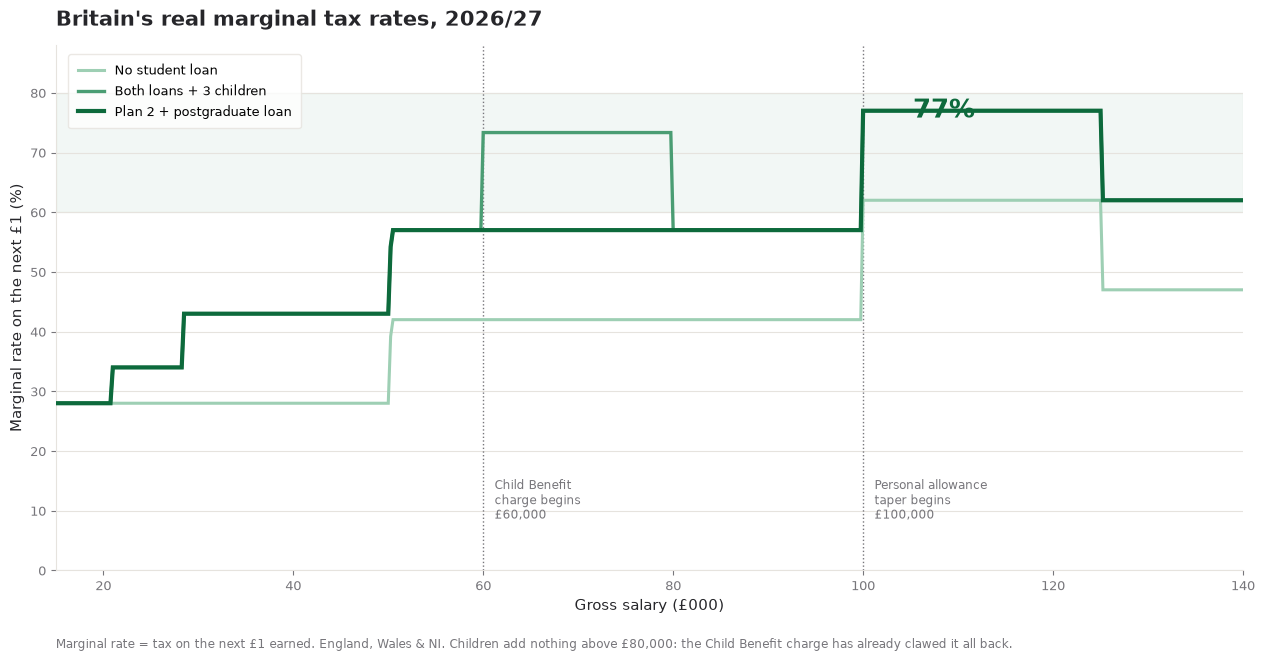
Effective marginal rate on the next £1 of gross salary, 2026/27, England, Wales and Northern Ireland. Includes income tax, employee National Insurance, the personal allowance taper, the High Income Child Benefit Charge and student loan repayments.
What a £1,000 pay rise is really worth
Prior work, and what this adds
High effective marginal rates in the UK are well documented. Tax Policy Associates set out how the Child Benefit charge and student loans push top marginal rates past 71%, and the Resolution Foundation has documented rates of 80% and above once Universal Credit and childcare support are included. The Economics Observatory explains the underlying mechanisms.
What this page adds is not a new discovery but a practical, current one: a complete map of the 2026/27 rates for every salary and family combination, updated for this tax year, with a free public calculator so anyone can find their own number rather than a representative case.
Why the rates stack
Each mechanism is defensible alone. The problem is that they overlap, and no single one is presented to taxpayers as part of a whole:
- Income tax at 40% in the higher-rate band.
- The personal allowance taper: above £100,000, £1 of the £12,570 allowance is withdrawn for every £2 earned, adding an effective 20 percentage points and creating the familiar 60% band up to £125,140.
- Employee National Insurance at 2% above the upper earnings limit.
- The High Income Child Benefit Charge: between £60,000 and £80,000, Child Benefit is clawed back in proportion to income. The more children, the steeper the effective rate. For three children this adds about 15.7 percentage points.
- Student loans: 9% above the Plan 2 threshold, plus 6% for a postgraduate loan, together adding up to 15 percentage points.
Dividends, where the rates just moved
Everything above is earned income. Dividends run on a separate set of rates, and they changed this year: the ordinary and upper rates each rose two percentage points on 6 April 2026, to 10.75% and 35.75%, with the additional rate unchanged at 39.35%. The dividend allowance stays at £500. Scottish taxpayers pay these UK rates rather than Scottish ones, because dividend income is reserved.
For anyone paid by their own company the number that matters is the combined rate, because the profit is taxed once in the company and again in your hands. On a pound of profit inside the corporation tax marginal relief band, where the effective company rate is 26.5%, a basic-rate owner keeps 65.6p and a higher-rate owner keeps 47.2p. That is a combined marginal rate of 34.4% and 52.8%. At the 19% small profits rate the same figures are 72.3p and 52.0p.
Those combined rates are what the dividend versus salary calculator compares against taking the money as salary, and the optimal salary and dividend split calculator sweeps every salary level to find the point where the total is lowest.
Methodology
We modelled the 2026/27 tax year for England, Wales and Northern Ireland, computing the change in total net income (take-home pay plus retained Child Benefit) for a £100 increase in gross salary at every £250 step between £20,000 and £135,000. The marginal rate is the proportion of that increase lost to tax, National Insurance, benefit withdrawal and loan repayments.
Parameters used: personal allowance £12,570, basic rate 20%, higher rate 40% from £50,270, additional rate 45% from £125,140, allowance taper from £100,000, employee NI 8% then 2% above £50,270, Child Benefit £27.05 a week for the eldest child and £17.90 for each additional child, High Income Child Benefit Charge tapering between £60,000 and £80,000, Plan 2 student loan 9% above £29,385 and postgraduate loan 6% above £21,000. Salary sacrifice, pension contributions and Scottish income tax bands are excluded.
The same engine powers our free public High-Earner Tax Optimiser, so any figure here can be reproduced.
Related research
We also mapped these bands onto published national pay scales: which UK professions sit inside the tax traps.
For journalists
These figures are free to reproduce with attribution to Compound Money and a link to this page, and the charts may be republished. We can run the numbers for any specific salary, family size or loan combination on request, and are happy to be quoted: hello@compoundmoney.co.uk.
Free Guide
Get the Compound Playbook
Every core move for building wealth in the UK, in one free PDF, including how to plan around these traps.
Free PDF plus occasional tips and offers. Unsubscribe anytime. Privacy.Related reading
The 60% tax trap explained · What frozen thresholds quietly cost you · High-Earner Tax Optimiser
Compound Money provides general information, not financial or tax advice. Figures are modelled estimates for 2026/27 and depend on individual circumstances.