
Corporation tax has a headline structure that sounds simple. Small companies pay 19%. Large ones pay 25%. In between there is something called marginal relief, which the name suggests is a discount.
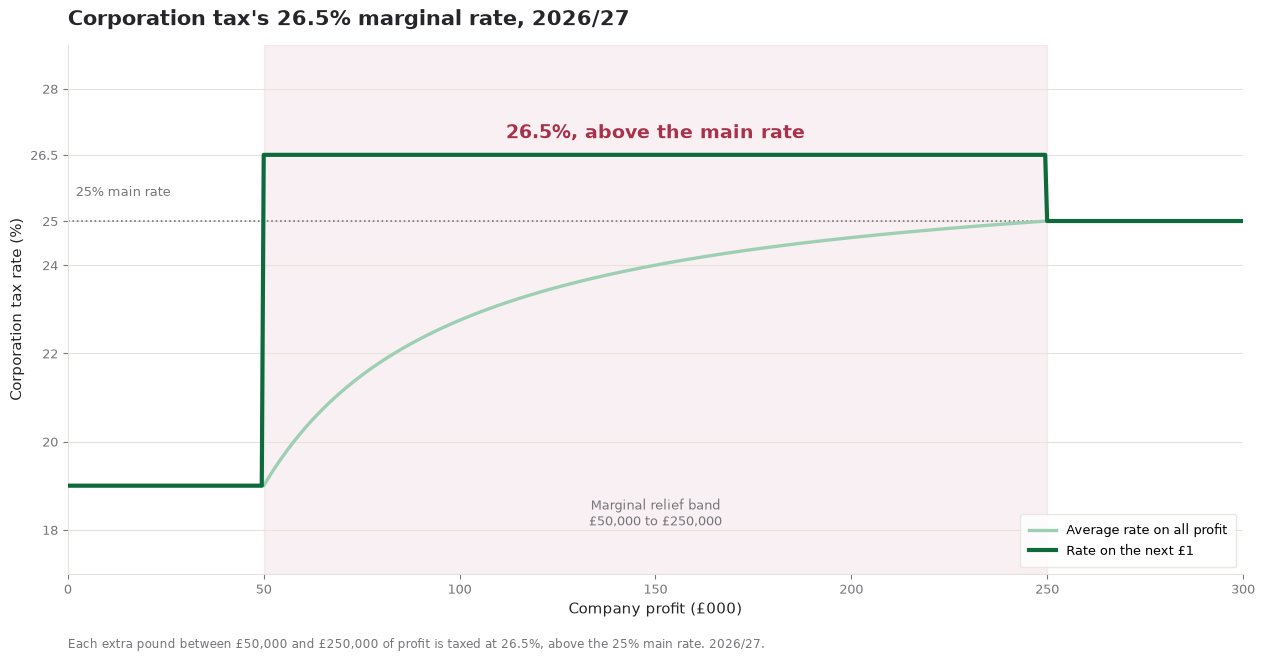
It is not a discount. Between £50,000 and £250,000 of profit, every extra pound is effectively taxed at 26.5%, which is higher than the 25% main rate that applies above it. Corporation tax has a marginal rate above its own top rate.
How a relief becomes a surcharge
The mechanism is arithmetic rather than policy. A company on £250,000 pays 25% on everything. A company on £50,000 pays 19% on everything. To get from one to the other smoothly, the tax on the profit in between has to rise faster than 25%, otherwise the two ends would not line up.
The Treasury implements this with a marginal relief fraction of 3/200, which produces an effective rate of 26.5% on each pound inside the band. The average rate you pay still climbs gently from 19% to 25%. It is the rate on the next pound that overshoots.
Marginal relief is the bridge between two rates. Walking across it costs more per step than standing at either end.
Free to reproduce with credit: download the animation or the still.
| Profit | Corporation tax | Effective rate | On the next £1 |
|---|---|---|---|
| £40,000 | £7,600 | 19% | 19% |
| £50,000 | £9,500 | 19% | 26.5% |
| £100,000 | £22,750 | 22.8% | 26.5% |
| £200,000 | £49,250 | 24.6% | 26.5% |
| £250,000 | £62,500 | 25% | 25% |
| £300,000 | £75,000 | 25% | 25% |
Why this is worth knowing
Because it changes what a deductible cost is worth. Spend £1,000 on something the company can deduct while your profit sits inside the band and you save £265 in corporation tax. Spend the same £1,000 when profit is above £250,000 and you save £250.
That is a modest difference on one item and a meaningful one across a year of decisions: employer pension contributions, equipment, a director's salary, bringing spending forward or pushing it back across a year end. All of them are worth slightly more inside the band than outside it.
It also explains something that surprises directors when they see it. Paying yourself a larger salary can be the cheaper route to extracting profit, precisely because salary is deductible at 26.5% while dividends are paid from profit already taxed. That is covered in the salary and dividend split.
The trap most people miss
The £50,000 and £250,000 thresholds are not per company. They are divided by the number of associated companies you control. Two companies under common control each get £25,000 and £125,000, so a business that looks comfortably inside the small profits rate can find itself in the marginal band simply because of a second company sitting alongside it.
This catches people who set up a separate company for a side venture, or hold property in one and trade in another. The definition of association is broader than most directors expect, and it is worth checking rather than assuming.
What to do about it
Nothing dramatic. This is not a trap to escape so much as a rate to know. If your profit sits between £50,000 and £250,000, deductible spending is worth 26.5p in the pound rather than 25p, and that is a small tilt in favour of doing it now rather than later. An employer pension contribution is usually the cleanest example: deductible, no National Insurance, and it moves money to you rather than to HMRC.
See what it means for how you pay yourself with the optimal salary and dividend split calculator, or compare a single extraction with the dividend versus salary calculator.
Method
Corporation tax for 2026/27: 19% on profits up to £50,000, 25% above £250,000, with marginal relief between the two at a fraction of 3/200. Marginal rates are measured on the next £100 of profit. Figures are computed rather than quoted.
General information, not tax advice. Associated company rules in particular are more involved than a short article can cover. Check your own position with your accountant.