
Ask what Scotland's top rate of income tax is and you get a clean answer: 48%, on income above £125,140. Both halves of that sentence are printed on the Scottish Government's own factsheet, and both are true in the narrow sense. Together they are misleading.
For anyone earning more than £100,000, the 48% rate actually starts just above £116,760. That is £8,380 earlier than the number in the table, and it happens for a reason nobody advertises.
Why the band moves
Scottish tax bands are not measured from zero. They are measured from the top of your personal allowance. The advanced rate runs until your taxable income reaches £112,570 above that allowance, and everything beyond it is charged at 48%.
Now recall what happens to the personal allowance above £100,000: it is withdrawn at £1 for every £2 you earn, until it disappears entirely at £125,140. This is the mechanism behind the well-known 60% trap in the rest of the UK.
Put the two together and the consequence follows immediately. As your allowance shrinks, every band above it slides down with it. The ceiling of the advanced band is a fixed distance above a moving floor, so the floor drops and the ceiling drops too. Cross the point where your taxable income overtakes that falling ceiling and you are in the top rate, whatever the headline threshold says.
The bands sit on top of the allowance. Shrink the allowance and the whole structure slides down with it.
Free to reproduce with credit: download the animation or the still.
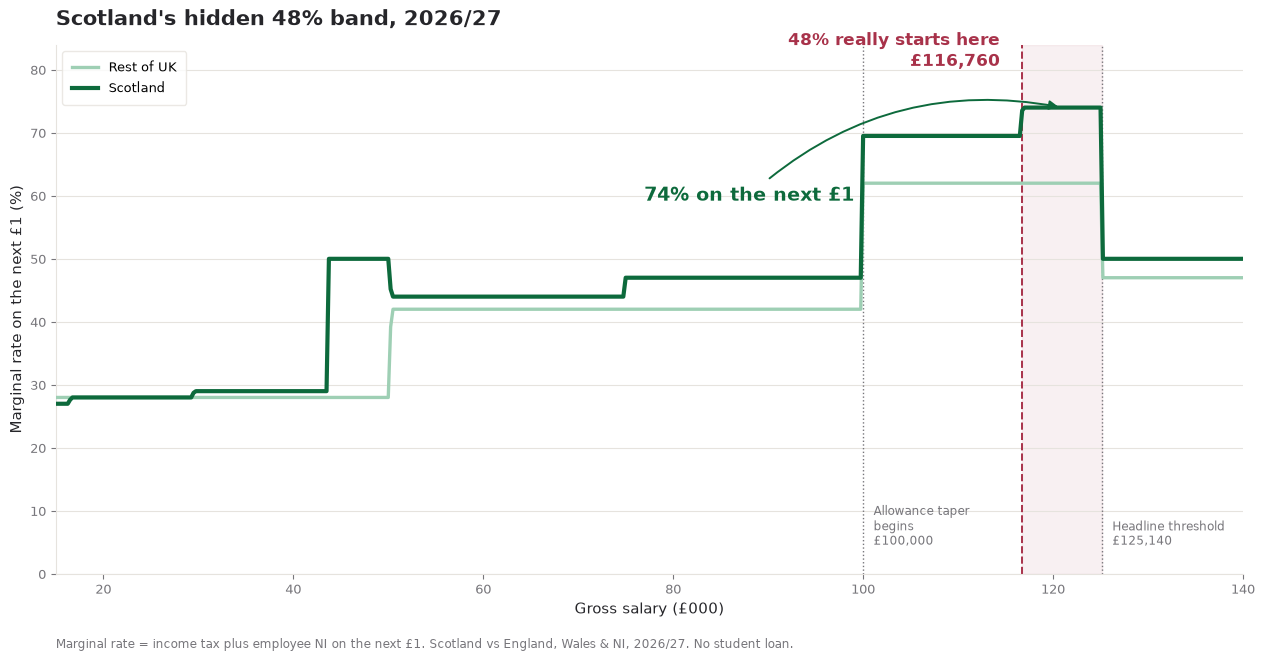
The arithmetic is simple enough to check by hand. Your taxable income is your salary less your allowance, and above £100,000 that allowance is £12,570 less half of everything you earn above £100,000. Set taxable income equal to £112,570 and solve, and you get £116,760. Our calculator, working from the published bands, lands on the same figure.
What it costs on the next pound
Inside that stretch, between roughly £116,760 and £125,140, the marginal rate on an extra pound of salary is 74%. That is 48% top rate, plus 24% from the allowance being withdrawn as you earn, plus 2% National Insurance.
Add student loans and it gets worse quickly. A Plan 2 loan takes it to 83%. A Plan 2 and a postgraduate loan together take it to 89%. On the same salary the equivalent figure in England, Wales and Northern Ireland is 77%.
At 89%, an extra £1,000 of gross salary leaves you with about £110 once everything has been taken.
Scotland against the rest of the UK
The gap is not uniform. Below roughly £33,500 a Scottish taxpayer pays slightly less than someone on the same salary elsewhere in the UK. Above it they pay more, and the gap widens sharply once the advanced rate arrives at £75,001, fully £50,139 before the rest of the UK reaches its additional rate.
| Salary | Scotland | Rest of UK | Difference |
|---|---|---|---|
| £20,000 | 28% | 28% | same |
| £35,000 | 29% | 28% | +1.0 |
| £60,000 | 44% | 42% | +2.0 |
| £90,000 | 47% | 42% | +5.0 |
| £110,000 | 69.5% | 62% | +7.5 |
| £120,000 | 74% | 62% | +12.0 |
| £130,000 | 50% | 47% | +3.0 |
Marginal rate on the next £1 of gross salary, including employee National Insurance. No student loan, no children.
The way out is the same as everywhere else
Pension contributions reduce the income the taper is measured against, which means they can pull you back below the point where the band structure collapses inwards. On a £120,000 salary in Scotland, sacrificing £20,000 to bring your adjusted income down to £100,000 costs your take-home about £5,954, an effective boost of 70.2% on the money going into your pension.
That is a better return than the equivalent move in the rest of the UK, for the unhappy reason that the rate you are escaping is higher.
One thing Scotland does not tax differently
All of the above applies to earned income. Dividends are a different matter: income tax on dividends is reserved to Westminster, so a Scottish taxpayer pays the same 10.75%, 35.75% and 39.35% as everyone else in the UK, on the UK thresholds rather than the Scottish ones. Those first two rates rose by two percentage points on 6 April 2026.
That matters most to company directors north of the border. Your salary is taxed on the Scottish bands and your dividends are not, so the salary and dividend calculation genuinely differs from the rest of the UK, and it moves in your favour: the higher Scottish rate on salary makes the dividend route relatively more attractive than it is in England. Work the trade-off through with the dividend versus salary calculator, or find the best split for your company with the optimal salary and dividend split calculator.
Model your own position with the take-home pay calculator, which now has a Scotland setting, or work out the contribution that escapes the taper with the high-earner optimiser. For the rest of the UK, see the 60% trap and our full map of marginal rates.
Method and sources
Scottish bands and rates for 2026/27 are taken from the Scottish Government's technical factsheet and cross-checked against separately published taxable-income figures. National Insurance and student loan thresholds are UK-wide. Every figure here is computed by the same engine that powers our calculators, so the article and the tools cannot disagree. Marginal rates are measured over a £100 step rather than a single pound, because the allowance is withdrawn in whole pounds and a single-pound step understates the effect.
General information, not financial or tax advice. Rates change, and your own position depends on circumstances this article cannot know.