Compound Research
Small Pension Pots: the Loophole Costs Most at £100k
Taking three £10,000 pots is often described as free money. It is taxed, and the rate peaks at 45% for someone earning £100,000, higher than for someone on £150,000.
Published 27 August 2026 · Modelled by Compound Money for the 2026/27 tax year · Free to reproduce with attribution and a link
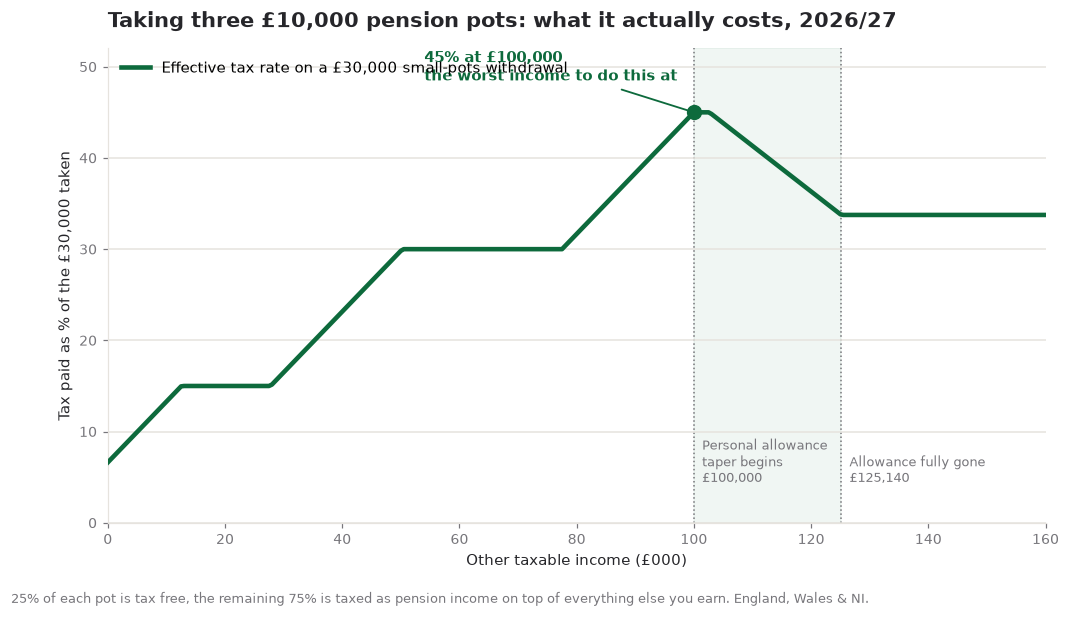
Free to reproduce with credit: download the chart.
What the numbers show
- A pension pot worth £10,000 or less can be taken as a single cash lump sum. Three such pots can be taken from personal pensions in a lifetime, so £30,000 in total. £7,500 of that is free of income tax and £22,500 is taxed as pension income on top of everything else you earn.
- The tax on that £30,000 is not a flat figure. It ranges from 6.6% to 45% of the amount taken, depending entirely on your other income.
- It peaks at exactly £100,000, where the taxable £22,500 runs straight through the personal allowance taper and is charged at an effective 60%. The bill there is £13,500.
- Above £125,140 the allowance has already gone, so the same withdrawal is taxed at 45% flat and costs less. Someone on £150,000 pays £3,375 less tax on an identical £30,000 than someone on £100,000.
What it costs, by income
| Other income | Tax due | Effective rate | Marginal rate at top |
|---|---|---|---|
| £0 | £1,986 | 6.6% | 20% |
| £12,570 | £4,500 | 15.0% | 20% |
| £30,000 | £4,946 | 16.5% | 40% |
| £50,270 | £9,000 | 30.0% | 40% |
| £80,000 | £9,500 | 31.7% | 60% |
| £100,000 | £13,500 | 45.0% | 60% |
| £110,000 | £12,396 | 41.3% | 45% |
| £125,140 | £10,125 | 33.8% | 45% |
| £150,000 | £10,125 | 33.8% | 45% |
The part that makes it a "loophole", and what it is worth
The reason this route is discussed at all is the money purchase annual allowance. Flexibly accessing a pension in the normal way triggers it, cutting what you can pay in each year from £60,000 to £10,000. A small pot lump sum is specifically not a trigger event, so it leaves £50,000 of contribution headroom intact.
That headroom is only worth something if you use it. Relieving £50,000 of contributions saves £11,432 of tax for someone on £60,000 and £19,946 for someone on £100,000. Set against the tax paid on the withdrawal, the break-even contribution is £35,300 at £60,000 and £33,800 at £100,000.
"The loophole is real, but it is a loan against your own allowance. You pay the tax now and only come out ahead if you genuinely have tens of thousands to contribute that you would otherwise have lost."
For most people who reach for small pots because they want the cash, that condition does not hold. The allowance they are protecting is headroom they were never going to fill.
Prior work, and what this adds
The rules themselves are well documented, by HMRC in the Pensions Tax Manual and by the consumer press. What is usually missing is the interaction: almost every explanation treats the tax as a flat 20% or 40% question and stops there. Because the taxable 75% stacks on top of other income, the true cost runs through the £100,000 to £125,140 band where the marginal rate is 60%, and that produces the non-monotonic curve above. We have not seen that peak quantified elsewhere.
Methodology
Every figure is computed from the same tax engine that powers the calculators on this site, so the page cannot disagree with them. We model an individual taking three uncrystallised personal pension pots of £10,000 each, at or after normal minimum pension age, with 25% of each paid free of income tax and the balance charged as pension income in a single tax year on top of their other taxable income.
Parameters used: personal allowance £12,570, basic rate 20% then higher rate 40% from £50,270, additional rate 45% from £125,140, personal allowance tapered by £1 for every £2 of income above £100,000, annual allowance £60,000, money purchase annual allowance £10,000. National Insurance is not charged on pension income and is excluded. Scottish income tax bands, the tapered annual allowance above £260,000 of adjusted income, and the lump sum allowance are excluded.
Sources: HMRC Pensions Tax Manual PTM063700 for the £10,000 limit, the age condition and the three-payment cap; PTM056530 for a small lump sum not being an MPAA trigger event; PTM056510 for the £10,000 MPAA from 2023/24; and GOV.UK for the annual allowance. Checked 19 August 2026.
One caveat worth stating plainly
Normal minimum pension age is 55 and rises to 57 on 6 April 2028. Anyone born after roughly April 1973 who is planning around this should assume 57. The three-pot limit applies to personal pensions; occupational schemes are treated separately, one payment extinguishing your entitlement under that scheme.
Related research
- When the 60% tax trap becomes 77%: UK marginal rates mapped
- Which UK professions sit inside the tax traps?
Related reading
- The 60% tax trap between £100k and £125k, and the legal way out
- Salary sacrifice: the higher earner's most underused move
- ISA or pension: where should your money go first?
- The 60% Tax Trap Calculator
Free Guide
Get the Compound Playbook
Every core move for building wealth in the UK, in one free PDF, including how to plan around these traps.
Free PDF plus occasional tips and offers. Unsubscribe anytime. Privacy.